
Gojim (Austria) / In a schtodt woss schtarbt
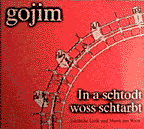
Gojim (Austria)
In a schtodt woss schtarbt
Extraplatte EX 307-2, 1997
In the US:
Hatikvah Music
436 N. Fairfax Ave.,
Tel: 213 655 7083 /
Hatikvah Music">Hatikvah Music
I have no idea who these people are, but this album arrives at a time when I am listening to tapes of Yiddish poetry set to new avant garde music by Naftule's Dream, and have been thinking a lot about a programme by Adrienne Cooper and Zalmen Mlotek, "Ghetto Tango," of music and songs of the Holocaust and pre-Holocaust era. It's as though there is suddenly an acknowledgement that it is time to look at more than klezmer and more than Yiddish folk song. It's time to look at other aspects of the thriving Yiddish culture that was eliminated by the Nazis.
At the same time, it has to be acknowledged that there is a strong "Jewish chic" among young German and Austrian intellectuals. Moreso even than here, klezmer is big in Germany. In that light, to be suddenly offered an album by non-Jews; a band appropriately called "Gojim," isn't the automatic turn-on that it might be. Whatever else this album is, it isn't klezmer. So, who knows? Maybe these are serious Austrian intellectuals busy recovering our lost poetry for us. Maybe they're just your average Austrian intellectuals and/or musicians fascinated by poetry that has long been forgotten and inaccessible. The liner notes are in German. Sadly, mine is poor. My Yiddish is not much better.
Still, here is what we have. A wonderful collection composed by Yiddish poets in Vienna in the 20s: "Der Erschter maj" (The first of May), "Hunger", "In Schlojme Hamelechss pardess" (In Shlomo Hamelech's orchard). The music, composed by the band, is Kurt Weill-ish. The singing and chanting of the words fits that Brecht/Weill mode quite nicely, with just a few avant gardeish and jazzy touches to remind us that the world in which these were written is gone. We're here now.
This is one of the most compelling albums of "lost" Yiddish poetry that I've listened to so far. I can't wait to hear other material by the band. And in the meantime, I also want to acknowledge the explosion of both new Yiddish poetry (Josh Waletzy, for instance, or a forthcoming recording session by Chava Alberstein and the Klezmatics) and of old poetry and song resung, reset where necessary: here, and by Cooper/Molotek and Naftule's Dream--and I presume these to be but the tip of the iceberg. These are exciting times. Yiddish hasn't been this alive since Hitler and his willing pals burned six million. To hear such an exciting and interesting setting to new material signals yet another dimension of Yiddish alive and meaningful in our time. In this particular case, as I said at the beginning of the paragraph, the result is compelling. The philosophy can rest. Many thanks to Hatikvah Music for making this available here in the US.
Reviewed by Ari Davidow, 1/24/98, minor revisions 3/22/98
Personnel this recording:
Caroline Koczan: vocals, percussion, drums
Petra Konecny: vocals, flutes
Maria Gollini: vocals, violin
Franz Ruttner: vocals, accordion
Katrin Schüler-Springorum: guitars, e-guitar, vocals
Bernhard Ziegler: double-bass, e-bass, vocals
- Balade I (words: Ber Horowitz; music: C. Koczan, arr; F. Ruttner) 1:00
- Memento mori (words: Mosche Lejb Halpern; music: K. Schüler-Springorum) 4:39
- Nont senen mir ale wunder (words: Dovid Kenigsberg; music: M. Gollini)
- In Schlojme Hamelechss pardess (words: Ber Horowitz; music: C. Koczan, arr; B. Ziegler) 1:33
- Un kumt di sun ... (words: S. J. Imber; music: trad., F. Ruttner) 3:21
- Legende (words: Dovid Kenigsberg; music: c. Koczan; arr. F. Ruttner) 2:34
- Hunger (words: Ber Schnaper; music: M. Gollini; arr. M. Gollini, K. Schüler-Springorum) 2:58
- Gewissen (words: Melech Rawitsch; music: F. Ruttner) 5:24
- Lewune-nacht (words: Ber Horowitz; music: M. Gollini) 2:21
- Di neschome is a kale (words: Dovid Kenigsberg; music: K. Schüler-Springorum) 1:32
- Mitog-midkejt (words: Ber Horowitz; music: C. Koczan; arr: F. Ruttner) 3:40
- Der erschter maj (words: Melech Chmelnitzki; music: trad., F. Ruttner) 2:34
- Winer ownt (words: Mendel Nejgreschl; music: C. Koczan; arr. F. Ruttner) 2:38
- Bam altwarger (words: Mendel Nejgreschl; music: C. Koczan; arr. B. Ziegler) 2:04
- In'm schandhojs (words: Mendel Nejgreschl; music: M. Cizek; arr. F. Ruttner) 5:36
- Di schtodt (words: Melech Chmelnitzki; music: M. Gollini)
- "Ouvertüre" (instr.) (music: trad., K. Schüler-Sringorum) 3:34
- Balade II (words: Ber Horowitz; music: C. Koczan; arr. F. Ruttner) 0:57


