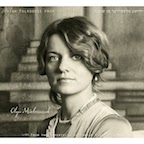
Help fund new Jewish cabaret program by Olga Mieleszczuk
Having given you the means to hear her music (and musicianship), I now pass on this note from Ellie Shapiro, Director of Berkeley, CA's Jewish Music Festival. Shapiro is currently on a Fulbright Fellowship in Poland.
Dear All:
Did you know that like Tin Pan Alley, Jewish musicians, lyricists, composers, presenters, radio and record producers were predominant in the Polish popular music industry between the wars? Jazz, cabaret, tango, film and theater in Polish, Hebrew and Yiddish … modern culture exploded in Polish large cities in the two decades of independence from 1919–1939. We're all familiar with the scene in Berlin from Cabaret … but Warsaw had its own rich, vibrant world. Most of the brilliant talents who created it did not survive the Holocaust.
The Polish-Israeli singer Olga Mieleszczuk has created a program with some of the most famous songs from this era. Titled Li-La-Lo, she has researched how some of the stars of the Polish stage also then created the cabaret scene in Tel-Aviv.
Bay Area JMF audiences will remember Olga from the opening concert of the 28th Jewish Music Festival with Polesye. She has now launched a funding campaign to support turning the Li-La-Lo project into a CD. This is music that deserves a wide hearing. I hope you will consider helping to bring it to a global audience. Please click on this link below to learn how you can!
 There have been a spate of recent CDs uncovering new (or in this case, sometimes new) repertoire. In this case, Folk singer/researcher Olga Mielszczuk has followed up on field recordings by Barbara Kirshenblatt-Gimblett made in the Polesye region of what is now Belarus, back in 1968–1975, from the repertoire of Mariam Nirenberg. Polesye was the ancient cradle of the Slavic peoples and a center of Hasidism. Nirenberg, a pre-War Jewish folksinger, was born in this multicultural region. What I find most compelling is the mix of older songs with 20th century repertoire—many were learned from the gramophone or other media in the early part of the century and reflected then-popular music. What is exciting is to hear them in the context of old and new from a specific region, and to hear them in modern settings, sung by a lovely voice backed by stellar musicians from Poland, Israel, and the US. I received this 2012 recording months ago and continue to enjoy listening to it. It has also become a great CD for long car trips. You can get your copy of Olga Mieleszczuk / Jewish folksongs from the Shtetl from
  I picked this up at a recent concert by the