
The Klezmatics / Possessed
Klezmatics
Possessed
Xenophile Records XENO 4050, 1997
43 Beaver Brook Rd.
Danbury, CT 06810
(203) 730-0333 / (800) 468-6644
Ever since the release of this new album, I have been receiving e-mail from friends about how the new Klezmatics album seems less "on the edge" than previous efforts. Such letters always conclude: "but I seem to be listening to it nonstop."
I do think that this new album is less raucous than Jews with Horns. Instead, I think that in many ways this album is deeper than previous efforts. There is more here to engage the listener past the first few listens (not that I've finished listening to Jews with Horns). "Moroccan Game" is no less experimental than songs that have come before. Many parts of the 'Dybbuk' suite (from the play by Tony "Angels in America" Kushner) push boundaries both in terms of the music, and in terms of the language. But the Klezmatics and others have extended the language of modern klezmer far enough that now they can safely, and most naturally, go deeper.
One way in which this album feels different is that it is more traditionally accessible. Despite the occasional jarring note (I love "Mizmor shir le-hanef (The Reefer Song)" musically, but I have a lot of trouble with songs that sanctify the use of drugs or alcohol*. What next? "Shir ha-alcohol?" Oops. That's the encore.), the album broadens the sense of what klezmer is. Sometimes that broadening is as simple as the English lyrics in "Fradde's Song" (it's bad enough that they're calling it klezmer and sing, but in English?--yes! English!) in an otherwise Yiddish context. There is also a reclamation of Biblical poetry, done not in modern Israeli style, but in a manner that feels, well, klez-ish in Sklamberg's adaptation of words from 'Song of Songs. Now it is as if there is a place, "virtual klez-land" with its own customs and accents and way of looking at both music (a dimension that embraces all musics, Jewish and non-Jewish, and which sees klezmer as a part of world music soup, originating from Jews, perhaps, but now playable and popular everywhere) and language and experience (a dimension sensitive to Jewish-specific experience, and, in the case of Svigals' "An undoing world", not klezmer at all, but of the specific American Jewish experience that informs much of what drives these particular, mostly Jewish musicians, to play this music in this time).
Whew. So, like I said, deeper. There's a lot here.
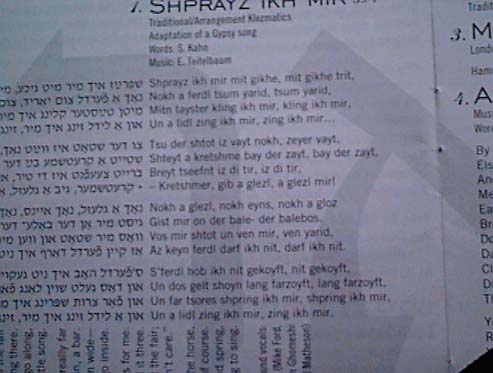 (This is probably where I should also put my notes about the lovely liner note design which places the Yiddish/Hebrew texts in correct juxtaposition to transliteration (Hebrew on the left side; transliteration on the right, for easiest use by the reader), with a fun sense of where to put the translation. The typographer in me notes that other fonts could have been chosen, and at times things are a bit crowded, but the overall effect is fun and actually accessible--far more accessible than what one usual sees. What a relief to see this done well, for a change.)
But as much as people, like myself, listen to klezmer in part because it touches on that mysterious sense of who we are as people of Jewish extraction in America, that isn't what keeps people listening to an album. For that, and for an album to still be thought of as a klezmer album, it has to move the body, bring you up to dance, cause the mind to do a few shers while the music plays in the background, maybe a mental freylekh or two, and on that level, the album is simply wonderful. You didn't need a whole review to tell you that. And, just to drive home how connected, and how interwoven all of this is, we have the selection of a cut by master klezmer (and all musics) cymbalomist Joseph Moscowitz as the intro to Dariau's 1997 all-purpose New York klezmer dance number, "Sirba Matey Matey". It's just Jewish soul music. In this case, it's damn fine Jewish soul music.
I'm dancing too hard to say this more succinctly. Go to the store. Purchase a copy of "Possessed." Put it on the turntable. Don't forget to eat or sleep occasionally. Enjoy.
Reviewed by Ari Davidow, 5/31/97. Further editing, 6/21/97.
Personnel this recording
Matt Darriau: clarinet, bass clarinet, alto saxophone, kaval, flutes, groggers
David Licht: drums and percussion
Frank London: trumpet, alto horn, groggers, percussion, accordion
Paul Morrissett: bass, tsimbl, fujara, nyenyere
Lorin Sklamberg: lead vocals, accordion, piano
Alicia Svigals: violin
Guests:
Adrienne Cooper: background vocals (4,7)
Moxy Früvious: background vocals (1,4)
John Medeski: Hammond organ, piano (3,4,5,6,7,14)
Avram Pengas: Bouzouki (5)
Songs
- Shprayz ikh mir (trad., arr. Klezmatics; adaptation of a Gypsy song; words: S. Kahn/Music: E. Teitelbaum) 3:04
- Kolomeyke (trad., arr. Klezmatics) 1:40
- Moroccan Game (London) 2:46
- An undoing world (music: Svigals/words: Tony Kushner) 3:40
- Mizmor shir lehanef / Reefer Song (music: London/words: Michael Wex) 5:14
- Shvarts un vays / Black and White (London/trad.--from the repertoire of Abe Schwartz) 4:07
- Lomir heybn dem bekher / Let us lift up a glass (music: Svigals/words adapted from poems by IJ Schwartz, A. Reisen) 4:20
- Sirba Matey Matey (trad., arr. Dariau) 4:54
Intro: Joseph Moskowitz, cymbalom; Max Yussim, piano (recorded July 19, 1916) - Mipney Ma (trad., arr. Klezmatics) 1:37
- Beggars' Dance (London) 2:20
- Shnaps-nign(Sklamberg) 1:51
- Interlude (trad., arr. Klezmatics) 0:36
- Dybbuk Shers (Svigals) 3:12
- Fradde's Song (music: London/words: Tony Kushner) 3:04
- Der shvartser mi adir / The black benediction (Morrissett) 2:13
- Hinokh Yafo / Look how beautiful (music: Sklamberg/words: Song of Songs) 4:06
- Mipney Ma (trad., arr. Klezmatics) 0:42
- Eyn Mol / One time (trad., arr. Sklamberg)
Music from "A Dybbuk: Between two worlds (songs 9–17)
Encore:
*I want to be clear that I am not anti-drug or anti-alcohol. I like drugs and alcohol, even together, at times. It is very much within the Jewish tradition to use them in moderation. But I have very major problems with the idea of getting stoned as a sacrament. [back]


